Logan Bennett · 17 October 2026
Britain's Shift Toward Sheep Grazing Between Solar Arrays Sparks Revised Agricultural Subsidy Calculations for Mixed-Use Farmland
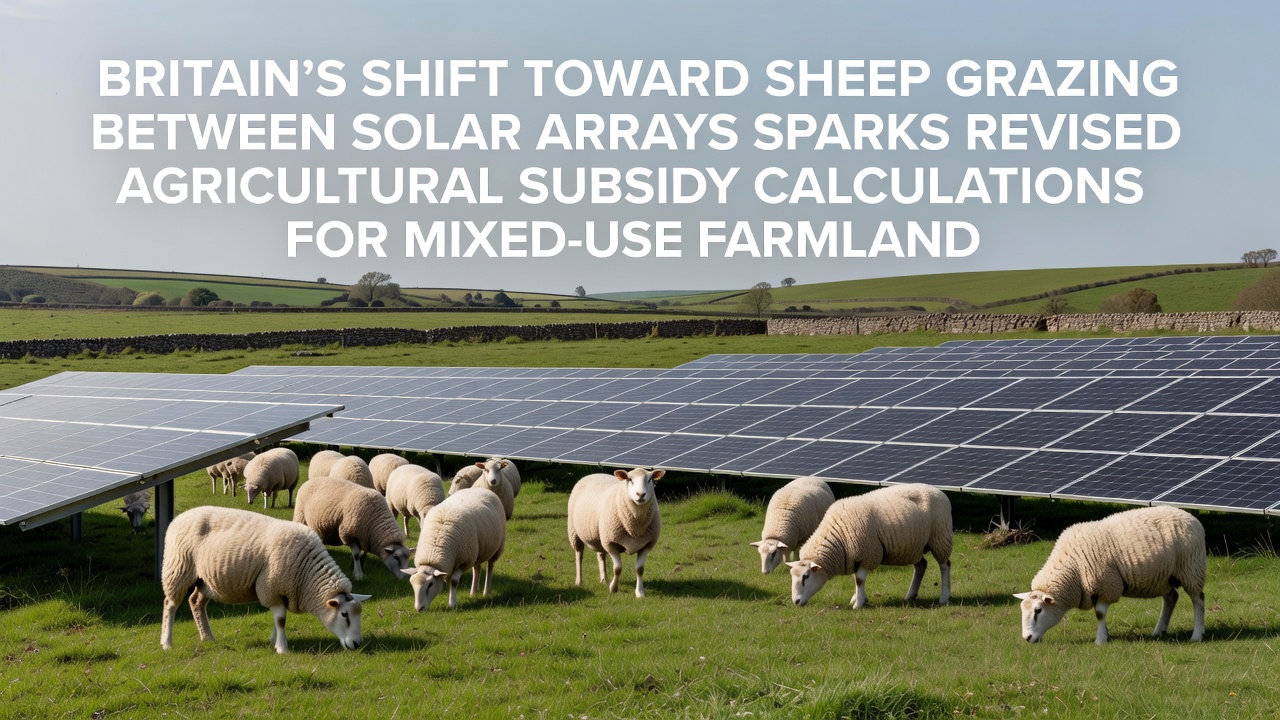
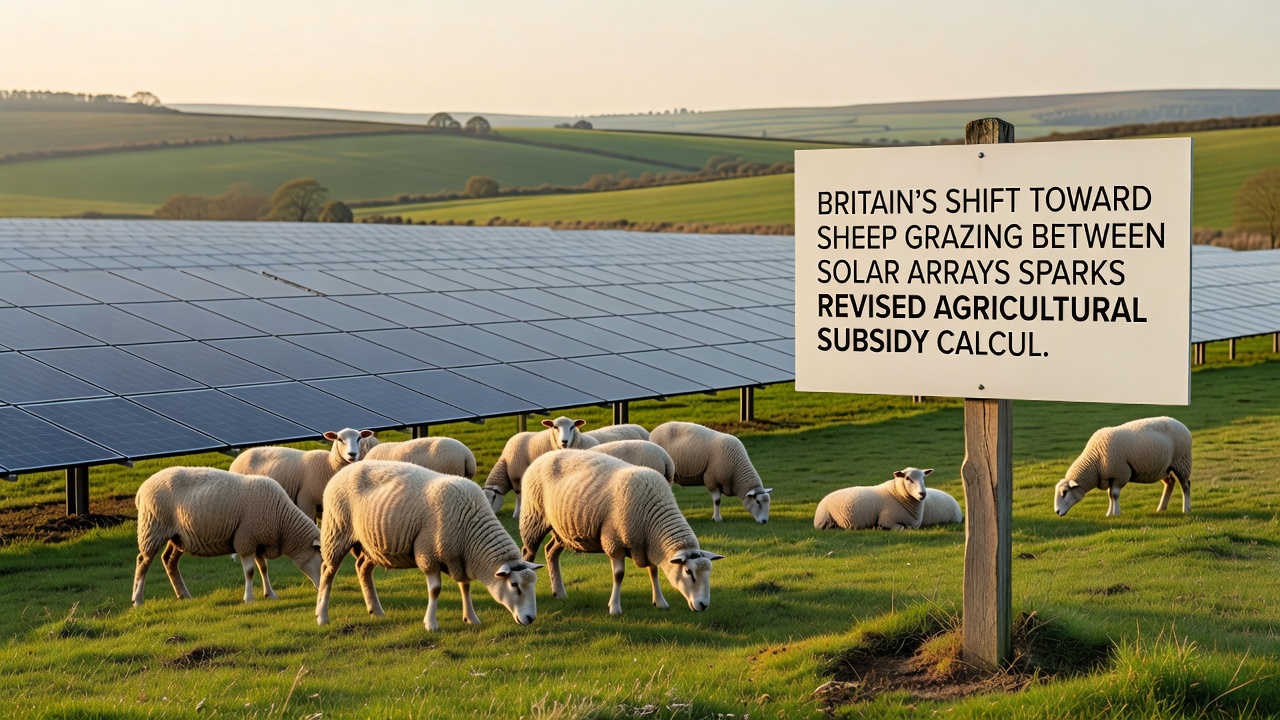
Britain has seen a steady rise in agrivoltaic systems where solar arrays share space with livestock grazing and observers note that sheep have become the preferred animals for maintaining vegetation under the panels because they fit easily between rows without damaging equipment while researchers from agricultural institutes have tracked how this dual-use approach alters land classification and payment eligibility under existing farm support schemes.
Data compiled through 2025 shows that more than 12,000 hectares of former arable land now host solar installations with integrated sheep grazing and government statistics indicate the practice expanded rapidly after 2023 when energy developers began incorporating livestock management plans into planning applications to meet biodiversity net gain requirements.
Changes in Land Use Patterns
Landowners who once relied solely on crop subsidies now combine solar lease income with livestock production and this combination has prompted the Department for Environment, Food and Rural Affairs to update its eligibility formulas for basic payment schemes so that mixed-use parcels receive adjusted rates based on the percentage of land occupied by panels versus open grazing areas while case studies from farms in Norfolk and Lincolnshire reveal that sheep stocking densities of four to six animals per hectare maintain grass cover without supplemental feed during most seasons.
Policy analysts at the European Commission have examined similar dual-use models across member states and their reports highlight how Britain's post-Brexit subsidy framework must account for both renewable energy output and continued agricultural activity on the same footprint.
Subsidy Calculation Revisions
Revised formulas introduced in October 2026 calculate support payments by weighting the productive capacity of pasture against the footprint of solar infrastructure and these calculations now incorporate satellite imagery plus on-site audits to determine exact grazed areas rather than applying flat rates across entire holdings.
Farm business surveys conducted by the Agriculture and Horticulture Development Board reveal that operators adopting sheep-plus-solar systems report stable or slightly higher net returns compared with single-use grazing because lease payments offset any reduction in traditional subsidy while the same surveys document lower herbicide costs since sheep control vegetation naturally under the arrays.
One study released by the University of Reading in early 2026 tracked twenty mixed-use sites over three years and found soil organic matter levels remained consistent with conventional pasture when rotational grazing was practiced and these findings have informed the new subsidy weighting system that rewards maintenance of soil health alongside energy generation.
Regional Examples and Data Trends
In Scotland and Wales similar installations have prompted parallel reviews of agricultural support payments although each devolved administration applies its own weighting coefficients based on local climate and land quality data while figures from the Office for National Statistics show renewable energy capacity on farmland rose by 18 percent between 2024 and 2026 with sheep grazing featured in 62 percent of those new developments.
Industry groups such as the National Sheep Association have published guidance documents that help farmers integrate livestock with solar infrastructure and these resources detail fencing layouts, water access points, and parasite management strategies tailored to array environments so operators avoid common pitfalls that could affect both animal welfare and panel performance.
Future Monitoring and Adjustments
Authorities plan further refinements to subsidy calculations after the 2027 planting season when additional data from ongoing trials will become available and these updates will likely incorporate metrics for biodiversity gains and carbon sequestration that sheep-grazed solar sites can deliver when managed according to established protocols.
International comparisons from Australia and Canada indicate that mixed-use farmland policies succeed when payment structures remain flexible enough to reflect actual productivity rather than theoretical maximums and British officials have referenced those models while drafting the October 2026 adjustments.
Conclusion
The integration of sheep grazing with solar arrays continues to reshape how agricultural subsidies are calculated across Britain and the October 2026 revisions represent the first systematic attempt to align payment formulas with the realities of dual land use while ongoing data collection from farms and research institutions will guide further refinements as the practice expands.